
Behold: some videos and photos from a trip to Greece in October 2025. This page is certainly a work in progress (as of 11/8/25). I hope to correct some errors from improvised videos, fill in some of the hard to hear audio, and links, etc.
This page will host my stuff from the Acropolis.
Here is some stuff from Santorini.
And here some stuff on Roman Athens.
Stuff from my visit to the Athenian Agora.
Below is my first Athenian video, just outside the modern entrance to the Acropolis, looking at a bit of the Areopagus, the “Hill of Ares” which once housed Athens’ Areopagus Council, which tried murder cases (and also did some other stuff, especially early on).
Here’s a next video, from the Propylaia, the entrance to the Acropolis. Audio quality isn’t great at the outset, but you get a feel for what it’s like to go up the Acropolis even in October (which is at the very tail end of the tourist season). If you want some better photos of the entrance (rather than just looking at me on the steps), try this site.
Here’s the next stop on the way up, this one looking out over the Areopagus, the Pynx, and the Hill of the Muses.
Here’s the next stop, looking back toward the temple of Athena Nike and the Propylaia (the entrance gate/complex) from atop the Acropolis. Here’s the deal re the “bosses” I was uncertain about in the video (the bosses are the protusions in the middle of many of the marble blocks on the walls of the Propylaia). They are indeed among the evidence that the Propylaia was never completed–the Athenians ran out of money during the Peloponnesian War (431-404) and never returned to finish the job. I don’t think I was halluncinating about bosses sometimes being left on for aesthetic reasons, but there’s other evidence in the case of the Propylaia for a lack of completion, including lack of the final levelling of its floor. The column bases, if looked at closely (not possible in any of my videos) look like they are in little depressions, because a thin layer of marble was left on much of the floor until construction was complete, to be removed after any chance of damage during construction was past. Many a large building remained unfinished in antiquity: they were immensely expensive, and if money or inspiration ran out, they often were left unfinished.
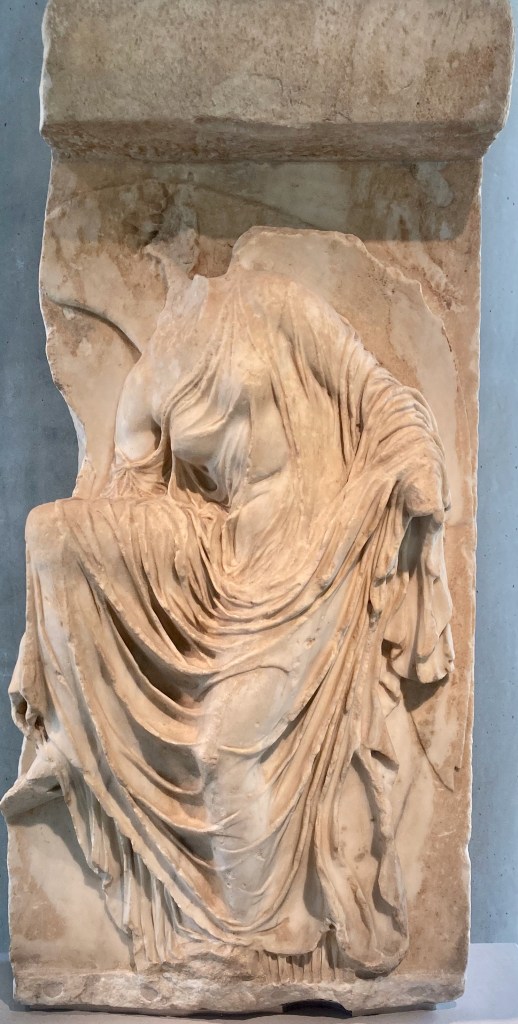
Here’s my photo of the famous Nike tying her sandal, from the Acropolis Museum.
And here we are outside the star attraction, the Parthenon. My comments about the frieze are hard to follow from this viewpoint–I get a better angle later.
And here’s the promised video showing the frieze from closer up.
A not so hot video of a not so hot set of remains, those of the temple (or perhaps altar) to Rome and Augustus. The audio starts garbled but gets clearer.
Now two, count them, two videos about the Erechtheion, delivered in two thanks to an act of God that led to a camera drop in the middle. The first features an innovative use of the term “left”.
A final video from the west end of the Parthenon, as my battery drained. Hey, it was my first day and Athens and I was jet-lagged enough not to bring the right cable for my battery pack.
Special bonus view: a silent (and somewhat off-kilter) view of the west part of the Parthenon frieze (most of which remains in Athens). It’s silent because it’s in a museum, where talking would have been particularly annoying to others; it’s off-kilter because I’m not much of a videographer, in case you haven’t noticed already. If you want a much more professional set of images (with informative text), try this fine site.
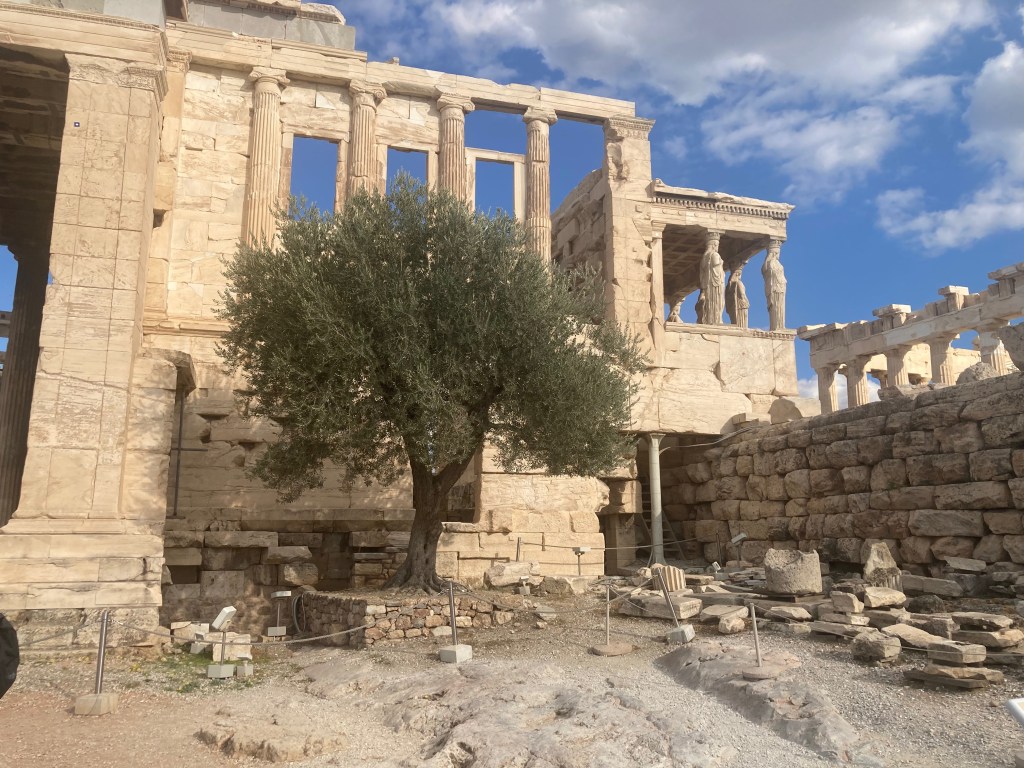
Finally, a photo of the olive tree planted to stand in for an olive sacred to Athena that grew in antiquity outside the Erechtheion (the building beyond the olive). The story goes that after the Persians took Athens and destroyed most of the buildings on top of it in 480, the olive tree sprouted a new shoot the next day. This isn’t that tree (this one was planted c. 100 years ago). But it’s an effort to restore an ancient connection between Athens, nature, and Athena.
 David M. Johnson